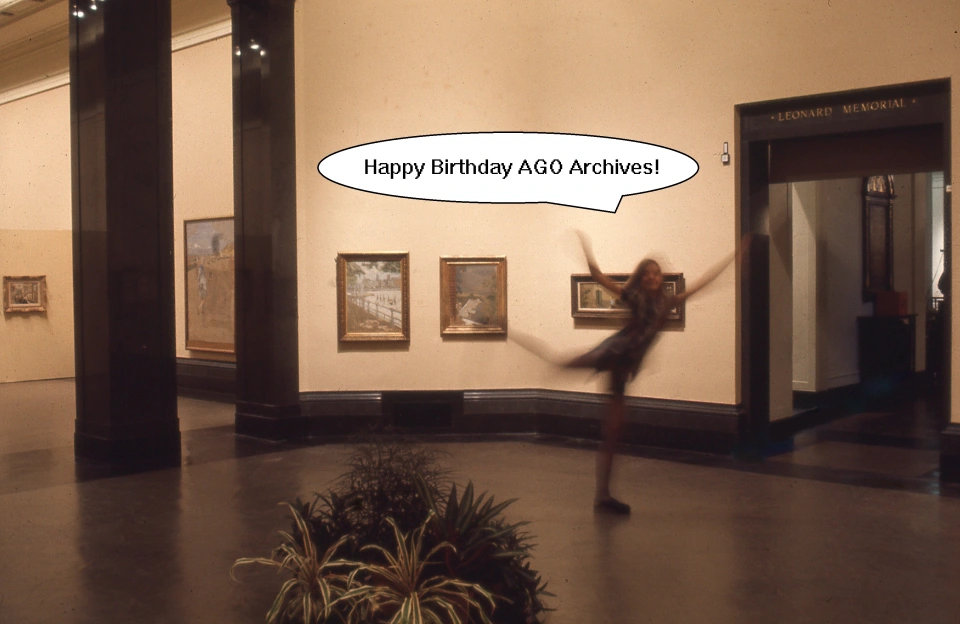
This year as we acknowledge the AGO’s 125th anniversary there are other significant milestones to note. For example, opening in November, Collective Visions celebrates 25 years of photography at the AGO. And next week, we will celebrate the 40th anniversary of Curators’ Circle, the AGO’s community of our most avid and generous annual donors. A special Curators’ Circle event will be held on Tuesday evening focusing on our collection. Some of our CC members have been making gifts every year since 1985 – 40 years straight.
Philanthropy accounts for a significant portion of our operating revenue and is crucial to everything we do at the museum. The AGO has a wonderful community of supporters who help us all fulfill our work every day – including Curators’ Circle members.
Take care,
Stephan
PS – Do take some time to view the Faye HeavyShield exhibition, currently on view. Faye was the 2021 recipient of the Gershon Iskowitz award at the AGO. If you are in the Gallery on Saturday, there will be a public talk with the artist as part of the exhibition’s official opening, at 2pm. Please join us!
For many of us, September signifies the start of something new; and here in the volunteer program, we are excited to announce that volunteer Ellen Miller begins her term as Volunteer Representative to the AGO Board of Trustees. In this role, Ellen and her fellow board members (27 voting trustees and up to two ex-officio, non-voting members) are responsible for the effective governance of the Gallery. Learn more about the membership of AGO’s Board of Trustees, here.
About Ellen:
A Gallery Guide since 2007, Ellen is a passionate volunteer whose childhood visits to the AGO with her father grounds her experience as a business founder, with board experience at Weizmann Canada and The Baycrest Foundation. She looks forward to applying her skills in strategic planning, financial management and relationship-building to support the Gallery’s governance and fundraising initiatives.
Barbara Glaser Continues as Volunteer President
In Volunteer leadership, Ellen is joined by Barbara Glaser, who, as Volunteer President, begins her second term. Passionate about volunteer recognition, and an advocate for honouring volunteers’ contributions and talents, Barbara has succeeded in strengthening relationships across our volunteer groups, shifts and programs, through the establishment of the AGO Volunteer Artist Collective, and a diverse and ambitious program of gallery outings and studio visits, in addition to her work spearheading the annual Volunteer Endowment Trust donation. Countless volunteers have shared their appreciation for Barbara’s natural affinity and hard work in reconnecting the community post-covid and we couldn’t agree more.
We thank Barbara and Ellen for their dedication in representing volunteers; and we look forward to supporting their contributions, both in the day-to-day program, and at the broader board level.
Holly Procktor, Coordinator, Volunteers & Alain Graham, Chief, People (HR)
This summer we have had healthy attendance. I really enjoy seeing people visiting us from all over the globe. Usually, our attendance is strongly linked to our exhibition schedule but this summer much of the visitor patterns reflect global political changes. It looks like we have had more Canadian and European visitors than we have in past years with fewer guests from our friends south of the border. One thing that I will miss is all the kids who attend our summer camps. Thanks to all who have been involved in making things a success.
There was an incident that occurred yesterday on the Ellis Don worksite at the AGO expansion in which an individual was taken to hospital for care. They are in my thoughts. Ellis Don has notified proper authorities and the situation is being investigated. It is important that we let the authorities complete the investigation and not speculate on what may or may not have happened. It is an important reminder to always work safely.
About 20 years ago, when I became the director of a very small museum in Oakland, California, above the door was an inscription in Latin that read, “Ars longa, vita brevis”: Art is long, life is short. It suggests that great art can transcend time and last for a long time, while human life is relatively brief.
I was reminded of the quote the other day when I saw a beautiful exhibition in the Indigenous & Canadian galleries entitled Remade: Clay, Plaster, Stone. It features the art of two Toronto artists, Frances Loring (1887–1968) and Florence Wyle (1881–1968). Although the artists are not particularly well known (they should be), the beauty of the sculptures feels timeless. The exhibition, curated by Renée van der Avoird, Associate Curator of Canadian Art, and Melissa Alexander, the W. David Hargraft Fellow in Canadian Art, is most beautifully installed, has very strong interpretation, and draws from our collection. It is a great example of the AGO doing what we do best – presenting great art to our audiences so they can learn and enjoy.
Curator and writer Ray Cronin on how Colville made the ordinary profound
Throughout the1960s and 1970s, from Toronto to São Paulo, painters began rejecting figuration and perspective, embracing colour, scale and line, in pursuit of a more expressive and immediate experience. Exploring this impulse is the current exhibition Moments in Modernism, a unique conversation between artists of the era.
Alex Colville. Woman in Bathtub, 1973. Acrylic polymer emulsion, Overall: 87.8 x 87.6 cm. Art Gallery of Ontario.
Nestled amongst the many large-scale abstract works on view, some of the most popular are those by Canadian painter Alex Colville (1920 – 2013), an artist whose highly controlled, but not quite real portraits of family and the Maritimes, have earned him fans around the world. Exploring Colville’s particular expression of place and his relationship to Modernism, the AGO welcomed Ray Cronin, Curator of Canadian Art at the Beaverbrook Art Gallery this past April, for a public talk.
Foyer reached out to Cronin to chat about why Colville continues to compel us and what makes him so modern:
Foyer: You’ve written a lot on Colville. What keeps you coming back to his work
Cronin: In part, it is because his work is so central to late modernity and is an existential response to World War II. He was someone who thought very long and hard about what it meant that the first half of the 20th century was chaos. His response to the bloodshed, the incredible tragedy of it all, was very thoughtful, very philosophical, and asked what it meant to be human in the world. It’s not unique – those questions permeated philosophy and art and culture in the 50s and 60s into the 70s. My father was a philosophy professor, and I always responded to Colville’s brand of thoughtfulness. Coming of age as a curator at a time when we struggled (and still do?) to understand what the post-modern is and worked against what came before, his works stuck out for me as something compelling, that can’t be dismissed.
Did you ever meet Colville?
I had the pleasure when I worked at the Art Gallery of Nova Scotia, to meet him several times. I got to visit him in his house, even had a couple conversations about philosophy. He loved that I had continued to read philosophy recreationally. A good friend of his, at Mount Allison, was a friend and colleague of my father’s. And he liked that connection.
There is an enduring perception of him as being a very isolated, withdrawn individual. Did he see himself that way?
He said himself that he went to Sackville to be isolated from the art world. But what he wanted was to avoid its influence. He wanted to be in a place where he could just concentrate on his own vision. That wasn’t very flattering to his colleagues at Mount Allison but was how he felt. After serving in the war, being a war artist, and having had an art studio in London, he consciously turns inward. Read more, in this week’s FOYER, linked HERE.
The AGO Library & Archives will be closing for annual collections maintenance starting today, Monday, August 18, until Friday, August 29. Library & Archives will resume regular service on Tuesday, September 2.
Hope you’re all well and enjoying the summer, albeit hot months! I’m delighted to announce our next Volunteer gathering will be a visit to the multi-disciplinary artist Michelle Peraza private studio, to meet her in person and take in her art. Most grateful for her generous offer in time and openness in sharing her art and philosophies with us in mutual dialogue. This will be similar to the outing I took you all on to Charles Pachter’s studio. An opportunity to mingle over various volunteer placements, meet other volunteers, inspired by art and the opportunity to meet the artist! You may know Michelle from when she was here at the AGO as Artist Michelle Peraza is a second-generation Latin American Canadian visual artist who centralizes LatinX identity and was AGO Artist in Residence last year. Personally, I absolutely love her art and highly respect her as an individual and artist.
A note from the artist: I was the artist-in-residence at the AGO from Aug to Oct 2024. I think this from AGO’s website will give an introduction of my work (and my website) BUT in my studio will be other works from the past year I would love to share!
This tour is limited in space and will be broken into two small groups, one at 11am and 12pm. This is first come, please RSVP and let me know if you can attend here via this link: https://forms.gle/w7bt9nbjHKGpmNbe9
Look forward to seeing you there!
Barbara Glaser. AGO Volunteer President.
Michelle Peraza artist website:
https://www.michelleperaza.com
About: In the discourse of coloniality. Through figuration and a research-driven practice, she explores themes of postcolonialism, transculturation, feminism, refusal, resilience, ambiguity, extraction and relocation, the dissemination of images, and representation. She seeks to engage with generational knowledge and memory by way of familial and women-centric ties. She creates large-scale figure paintings in oil of individuals close to her, people often dismissed from the art historical canon. In tandem with painting, she explores a material-based practice working with 23k gold leaf, genuine silver leaf and amate/amatl (Mesoamerican tree bark paper) as an-other method of deconstructing the colonial narrative of power. Drawing and site-specific installation serve as ways to explore world-making aesthetic strategies and speaks to the exhaustion of natural resources in the Global South. Recent research and creation draws inspiration from scholars, artists, and scientists speaking from the margins, engaging with the Alt-anthro-scene (as opposed to the Anthropocene), the Chthulucene and Mesoamerican cosmovision to explore the intersections of feminism, race, climate and health and the asymmetry of the current geological age. This research is inspired by the colonial-led movement of plant life throughout the globe, the dissemination of drawn and painted botanical images, our lived and embodied experiences of plants, geological strata, entanglement, mending, plant properties of healing, experimentation in natural dyeing with plants, and aligning her creative practice to the sun and the moon patterns.
Opening Saturday August 9, a new exhibition at the Gallery brings together a selection of rarely seen sculptures by Toronto artists Frances Loring (1887–1968) and Florence Wyle (1881–1968).
Deer Panel (c. 1939-1941) will be exhibited for the first time since 1944 as part of the AGO exhibition Remade: Clay, Plaster, Stone. (2nd Floor, Gallery 238)
EXHIBITION OVERVIEW Toronto artists Frances Loring (1887–1968) and Florence Wyle (1881–1968) dedicated much of their careers to raising public awareness for sculpture. In this exhibition, Renée van der Avoird, Associate Curator of Canadian Art, and Melissa Alexander, the W. David Hargraft Fellow in Canadian Art, present a selection of rarely seen sculptures from the AGO’s Collection, highlighting Loring and Wyles’s commitment to the artform and their conviction that sculpture is a lifelong process. The ten works on view are made of various materials and at various stages of completion; they will be displayed alongside archival materials and an interview with the artists, dating from 1965.
ABOUT THE ARTISTS Born in Trenton, Illinois, in 1881, Florence Wyle studied medicine at the University of Illinois before shifting her focus and enrolling at the Art Institute of Chicago. It was there, while she served as an instructor for life modelling, that she met her lifelong companion, Frances Loring, in the fall of 1906. Frances Loring, born in Wardner, Idaho, in 1887, had previously studied sculpture at the École des Beaux-Arts in Geneva and the Académie Colarossi in Paris. The pair moved to New York to begin their careers before permanently settling in Toronto in 1912.
Throughout their lives, Loring and Wyle were dedicated to the promotion of Canadian sculpture, and their numerous public art commissions can be seen throughout Canada. Because of this, when they passed away in 1968, their joint wills outlined the creation of the Sculpture Fund to encourage both Canadian sculpture and its artists. In 1983, their estate was gifted to the Art Gallery of Ontario.
This Week’s Foyer includes an essay by Melissa Alexander, the W. David Hargraft Fellow in Canadian Art, detailing one of Loring’s architectural models, with notes from Lisa Ellis, Conservator, Sculpture and Decorative Arts; and Justina Yu, Conservation Intern, Paintings, linked HERE.
The Henry Moore Centre, Murray Frum Gallery, and Irina Moore West and East Galleries will be closedon Friday, August 8, from 6 am to 1 pm as EllisDon will be lifting the new Air Handling units for the Dani Reiss Modern and Contemporary Gallery (DRMCG) into position in the new building.
Staff, volunteers, and visitors are not allowed in these galleries during this time due to safety concerns. These galleries will be stanchioned off with signage for the duration of the lift.
Questions?
Reach out to Lenore McMillan, Project Coordinator, Dani Reiss Modern and Contemporary Gallery, at [email protected]
I was looking at my photos from the past week and I wanted to share three of them before signing off. On Wednesday, the community welcomed Thomas J Price’s sculpture Moments Contained (2022) to Toronto. Performances by singer Shakura S’Aida and a gospel choir led by Kiara Picart created a celebratory atmosphere for hundreds of folks, including many of you. It was a joyful and powerful event.
Moments Contained is both straightforward and complex. On the one hand, it is simply a beautiful 9-foot bronze of a woman standing in front of the AGO. Large sculptures in front of museums are actually very common. On the other hand, the bronze depicts a clothed woman (quite rare) who is of African descent (extremely rare).
The monumental size is very apparent from up close, but when I was walking to work on Thursday morning there were very few people in front of the museum and, from a distance, she just looked like a Torontonian waiting for a cab! Often, great works of art shift meaning depending on their context. I am pretty sure in January I will be thinking that she is underdressed for the weather!
This project was made possible because of our incredible and dedicated staff.